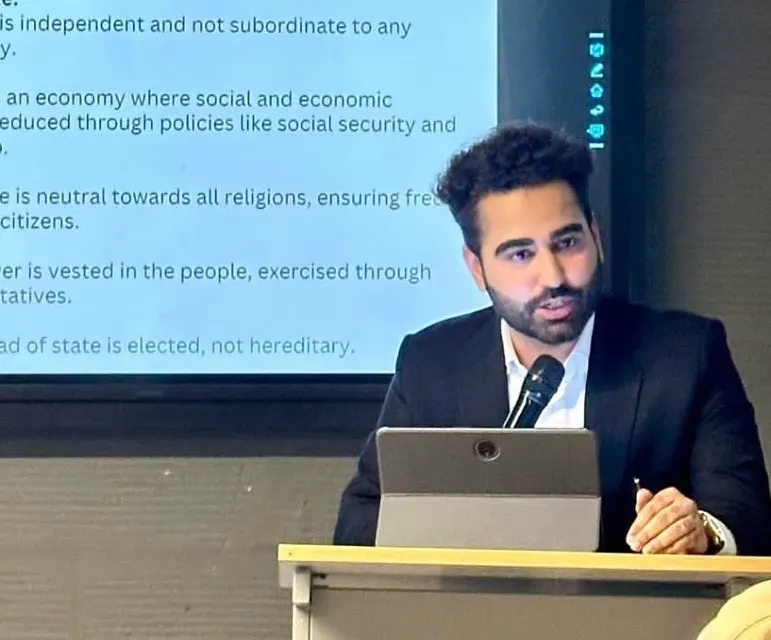
In Conversation with Nikhil Chugh, Advocate and Author
Nikhil Chugh, Advocate and Author, speaking on legal awareness and constitutional rights.
Nikhil Chugh, Advocate and Author: Educating Citizens About FIR, Bail and Police Procedure
Feature Interview | nikhilchugh.in
Legal awareness remains one of the most essential yet under-discussed pillars of a democratic society. In a country governed by a detailed and complex legal framework, citizens often encounter institutions of law without fully understanding the rights and protections available to them. Awareness of basic criminal procedures such as FIR registration, arrest safeguards and bail provisions therefore becomes critical for safeguarding civil liberties.
In this exclusive conversation, Nikhil Chugh, Advocate and Author, speaks about his journey into the legal profession, his academic background in constitutional law, and the inspiration behind writing his book “Legal Rights Every Citizen Must Know: FIR, Bail and Police Procedure Under India's New Criminal Laws (BNSS 2023)”. The book seeks to simplify complex criminal procedures and make legal knowledge accessible to ordinary citizens.
Q. To begin with, could you introduce yourself to our readers?
I am Nikhil Chugh, Advocate and Author based in Panipat, Haryana. My academic journey in law began with a BA.LLB (Hons.) from Chandigarh University, followed by an LL.M in Constitutional Law from Kurukshetra University. In addition to my legal studies, I also completed an MBA in Finance from Kurukshetra University, which helped me understand governance systems and regulatory structures from a broader institutional perspective.
Alongside advocacy and legal research, I remain engaged in initiatives aimed at promoting legal awareness and constitutional literacy among citizens.
Q. Tell us about your early life and what led you toward the study of law.
Growing up in Haryana, I developed a strong interest in public institutions and governance. During my academic years, I became increasingly curious about how laws shape everyday life and how constitutional principles influence the functioning of democratic institutions. That curiosity gradually transformed into a deeper engagement with legal studies and ultimately guided my decision to pursue a career in law.
Law is a discipline where questions of justice, rights and governance intersect. For me, it represented an opportunity not only to study the legal system but also to contribute to strengthening public understanding of it.
Q. What inspired you to write a book on FIR, bail and police procedure?
The idea for the book emerged from a simple but important observation: many citizens encounter the criminal justice system without knowing their basic legal rights. Situations involving FIR registration, arrest or bail often create confusion and anxiety because procedural law can appear technical and difficult to understand.
With the introduction of India's new criminal law framework, particularly the Bharatiya Nagarik Suraksha Sanhita (BNSS), there was a clear need to explain these legal provisions in simple and accessible language. My objective in writing the book was to bridge the gap between complex legal texts and everyday understanding.
Q. What do you hope readers will gain from your book?
The central aim of the book is to promote legal awareness. When citizens understand the processes governing FIR registration, arrest safeguards and bail provisions, they become more confident in interacting with institutions of justice. Legal knowledge empowers individuals and strengthens democratic accountability.
Q. What are your future plans as an author and legal professional?
I hope to continue contributing to legal awareness and constitutional education through writing, research and public engagement. Law should not remain confined to courtrooms or academic institutions; it should be accessible to the public. My long-term goal is to keep working toward simplifying legal concepts for citizens.
Q. Finally, what message would you like to give to young law students and aspiring lawyers?
Law is a demanding but intellectually rewarding profession. I would encourage young law students to develop a strong foundation in constitutional principles, remain curious about public institutions, and approach the profession with integrity and responsibility. Ultimately, the legal profession carries the responsibility of upholding justice and protecting the rights of society.
About the Author
Nikhil Chugh is an Indian advocate, legal educator and author based in Panipat, Haryana, and a member of the Supreme Court Bar Association.
He holds a BA.LLB (Hons.) from Chandigarh University, an LL.M in Constitutional Law from Kurukshetra University and an MBA in Finance from Kurukshetra University. He is also UGC NET qualified and currently serves as a Legal Research Officer at the All India Council of Human Rights, Liberties & Social Justice (AICHLS).
He is the author of the book “Legal Rights Every Citizen Must Know: FIR, Bail and Police Procedure Under India's New Criminal Laws (BNSS 2023)”.
By Nikhil Chugh, Advocate | Supreme Court Bar Association Member | Panipat District Court